|
|
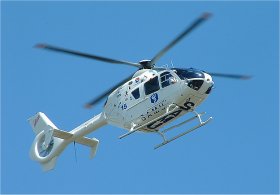 |
The EC-135 is intended as a replacement for Eurocopter's successful BO-105 light twin, and is developed from the BO-108 technology demonstrator.
The original MBB BO-108 was intended as a high technology helicopter demonstrator, and as such incorporated a range of high technology features including a hingeless main rotor (Sikorsky and Boeing adopted this design for their military RAH-66 Comanche), all composite bearingless tail rotor, shallow transmission (allowing greater cabin height) with special vibration absorbers, composite structures, improved aerodynamics, modern avionics and EFIS instrumentation.
The success of the BO-108 test program led to MBB's announcement in January 1991 that it would develop a production 108 with Arrius or PW-206 engines as a replacement for the BO-105.. However the formation of Eurocopter (in January 1992) gave the program access to Aerospatiale's Fenestron shrouded tail rotor technology which was then incorporated into the design.
The combination of the BO-108 and the Fenestron led to the definitive EC-135 flying for the first time on February 15 1994. German certification was granted on June 14 1996, while US approval was given on July 31 that year, the same day as the first customer delivery.
The PW-206 powered model is designated EC-135P-1, the EC-135T-1 has the Arrius 2B1. |
 |
|
|
|
| Seating (normal) |
5 |
Max Takeoff (lbs) |
6,250 |
| Seating (maximum) |
6 |
Certified Ceiling (ft) |
10,000 |
|
| Engines |
2 Turbomeca Arrius 2B2 |
To (Sealevel, ISA Temp) (ft) |
- |
| Output lbs ea. Flat Rating |
571shp |
Landing Distance (ft) |
- |
| Maximum Mach No. |
- |
Max Range (fuel) (nm) |
334 |
| High Speed Cruise (Kts) |
138 |
Max Range (payload) (nm) |
334 |
|
| Flight Time 300nm |
- |
Flight Time 1000nm |
- |
| Flight Time 600nm |
- |
|
|
|
| External |
|
Internal |
|
| Length (ft) |
33.40 |
Length (ft) |
10.30 |
| Height (ft) |
11.40 |
Height (ft) |
4.10 |
| Span (ft) |
8.50 |
Width: Max floor (ft) |
4.80 |
|
|
|