|
|
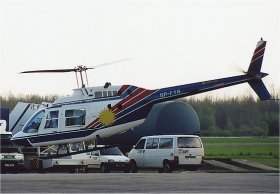
The JetRanger can originates back to an unsuccessful contender for a US Army competition for a light observation helicopter, which was won by the Hughes 500. In the early 1970s production changed to the Model 206B JetRanger II with a 400shp (300kW) 250C20 turboshaft, while conversion kits to upgrade earlier As to the new standard were made available. The third major variant of the JetRanger is the 420shp (315kW) 250C20B powered JetRanger III, with first deliveries commencing in late 1977. Once again Bell offered a conversion kit to update earlier JetRangers to the new standard. Other features introduced on the JetRanger III were a larger and improved tail rotor and minor modifications.
JetRanger production was transferred from Texas to Mirabel in Canada in 1986, where the current production model remains the 206B3 JetRanger III. |
 |
|
|
|
| Seating (normal) |
3 |
Max Takeoff (lbs) |
3,200 |
| Seating (maximum) |
4 |
Certified Ceiling (ft) |
13,500 |
|
| Engines |
Rolls Royce 250 C20J |
To (Sealevel, ISA Temp) (ft) |
- |
| Output lbs ea. Flat Rating |
270shp |
Landing Distance (ft) |
- |
| Maximum Mach No. |
- |
Max Range (fuel) (nm) |
365 |
| High Speed Cruise (Kts) |
118 |
Max Range (payload) (nm) |
365 |
|
| Flight Time 300nm |
- |
Flight Time 1000nm |
- |
| Flight Time 600nm |
- |
|
|
|
| External |
|
Internal |
|
| Length (ft) |
31.10 |
Length (ft) |
7.00 |
| Height (ft) |
9.40 |
Height (ft) |
4.10 |
| Span (ft) |
6.30 |
Width: Max floor (ft) |
4.10 |
|
|
|